It firms up for a week. Then the paws start again.
The soft-serve mornings and the 2 a.m. scratching feel like two separate problems with the same dog. For a lot of dogs, they aren't two problems. They're one, and it's the reason the chicken-and-rice, the pumpkin, the prescription bag and the round of metronidazole all seem to work for a week, then wear off.
You know the rhythm by heart. A few good days. One genuinely firm morning, the kind where you hear yourself say "good boy" out loud at a turd like a lunatic. Then a soft one. Then, a night or two later, the thump-thump-thump of a back leg going at an ear that was fine on Tuesday.
Somewhere in there a vet probably told you it "could be anything." You've spent real money chasing that "anything." For a lot of owners it's well past a thousand dollars, just for the diarrhea. And the part that wears you down isn't the cleanup, though the 3 a.m. rug-scrubbing is its own special hell. It's that nothing holds.
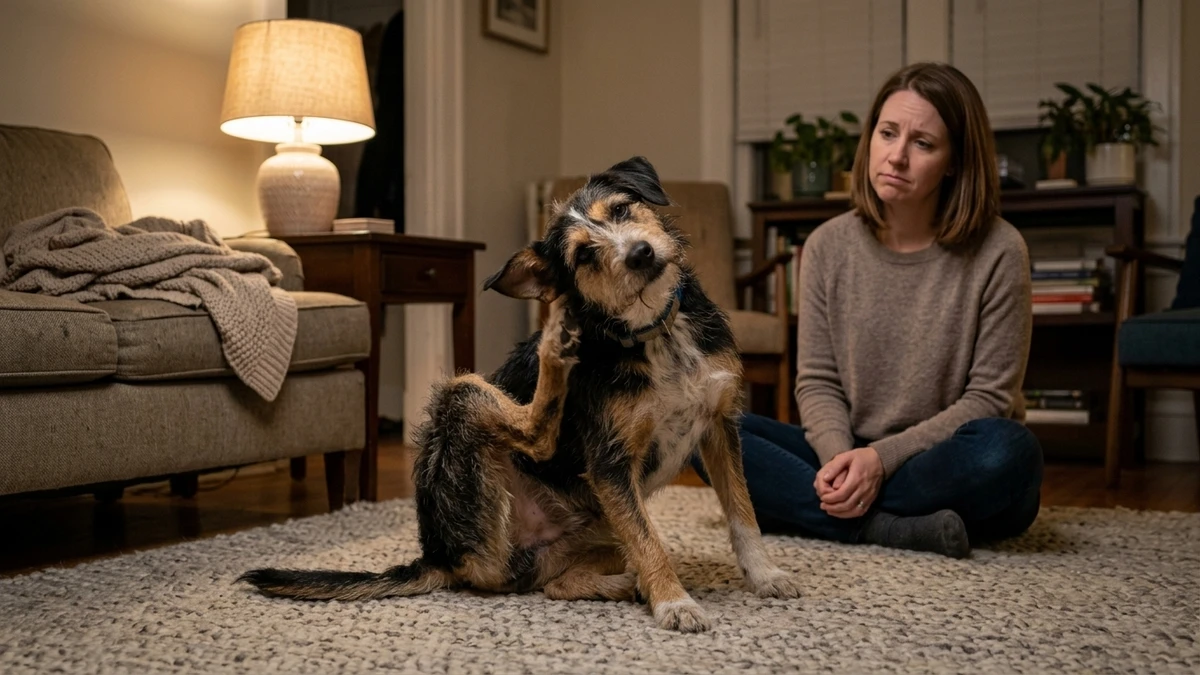
So this isn't another listicle of things to try. You've tried them. This is the one thing nobody connected for you: why the bad gut and the itchy skin keep dragging each other back down, and why the fixes that target one of them never quite end either.
The two things you were told were unrelated
Here's what the soft-stool dog and the paw-licking dog have in common: they're usually the same dog.
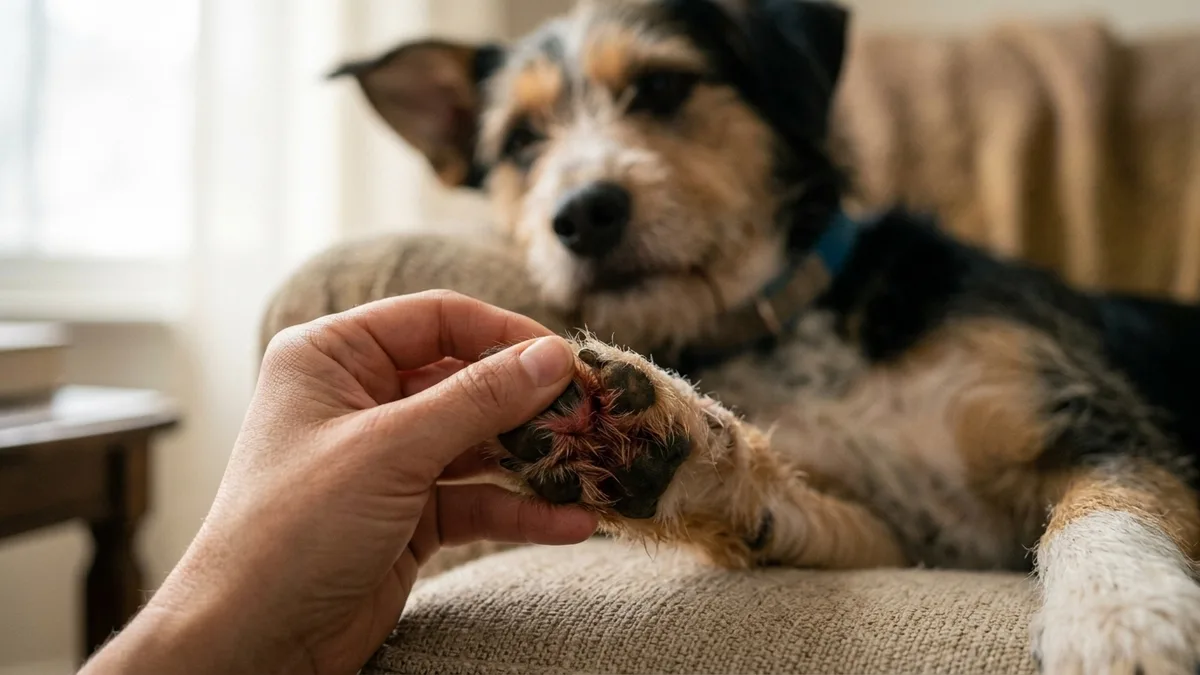
The faintly corn-chip, "Frito feet" smell. The wrinkles or toes that go pink and yeasty overnight. The ears that flare for the third time this year. And the gas, the urgency, the soft-serve. Most owners get handed these as a pile of separate complaints (a skin thing for the dermatologist, a gut thing for the GI workup) and never told they tend to run together because they share a root.
Vets have a name for the wiring: the gut-skin axis. Most of a dog's immune system actually lives in the gut. When the population of good bacteria in there gets thinned out, two things happen at once: digestion gets loose and urgent, and the immune system starts overreacting, which surfaces as inflammation, yeast, and itch. One imbalance, two addresses.
That's why the medicated shampoo takes the edge off but never finishes it, and why the antihistamine helps until it doesn't. They're working on the skin while the thing feeding the itch keeps topping itself up from the inside.
Why it keeps coming back
Once you see it as one problem, the relapse loop finally makes sense.
Take the round of metronidazole. It works: her stool firms up within days. Then the course ends and within a week or two she's back to soft-serve. That's not bad luck. Antibiotics clear the bad bacteria and most of the good ones with them, and newer research suggests metronidazole can knock the gut community around more than it helps over the long run. You weren't fixing the balance. You were stripping it further while papering over the symptom.
The rest of the toolkit has the same ceiling, and you've probably already found it:
- Bland chicken-and-rice rests an irritated gut. It's a reset, not a repair. Reintroduce the regular food and a lot of dogs slide right back.
- Pumpkin adds fiber that can bulk up a loose stool. For some dogs it does nothing, or loosens things further. Either way it manages the exit, not the cause.
- A food switch sometimes calms a true protein reaction, but if the gut balance is already gone, the new bag often goes soft too, and every abrupt change risks restarting the diarrhea you're trying to stop.
- And the probiotic you already tried (the FortiFlora, the tub from the pet store, the one you gave religiously): that's the one that stings, because it felt like the right idea. "Tried a probiotic, it did nothing" is one of the most common things owners say. It almost never means probiotics don't matter for dogs. It usually means that particular one never actually arrived. More on that in a second, because it's the crux.
The part nobody told you about the itch
The skin half deserves its own paragraph, because it's the half that gets treated as a totally separate disease.
When the gut barrier gets leaky and the immune system is on a hair-trigger, the body's overall inflammatory load goes up and the bar for yeast to overgrow drops. That shows up exactly where you've been seeing it: the paws she licks raw, the warm yeasty ears, the patch of thin fur, the smell. It reads like an allergy, and you may well also be chasing a real food allergy with your vet, which is worth doing. But for the gut-skin dog, a big share of that itch is downstream of the bowl.
And there's real research on this now, not just forum hunches and a hopeful owner connecting dots. In a 2024 study, dogs with chronic itchy skin got better when the imbalance in their gut was corrected: the skin cleared as the gut did. Settle the gut, and the skin tends to settle a few weeks behind it. The connection you'd sensed but were never handed is real.
Why your last probiotic did nothing
Now the crux. There are two reasons a probiotic comes up empty, and neither is the one you'd guess.
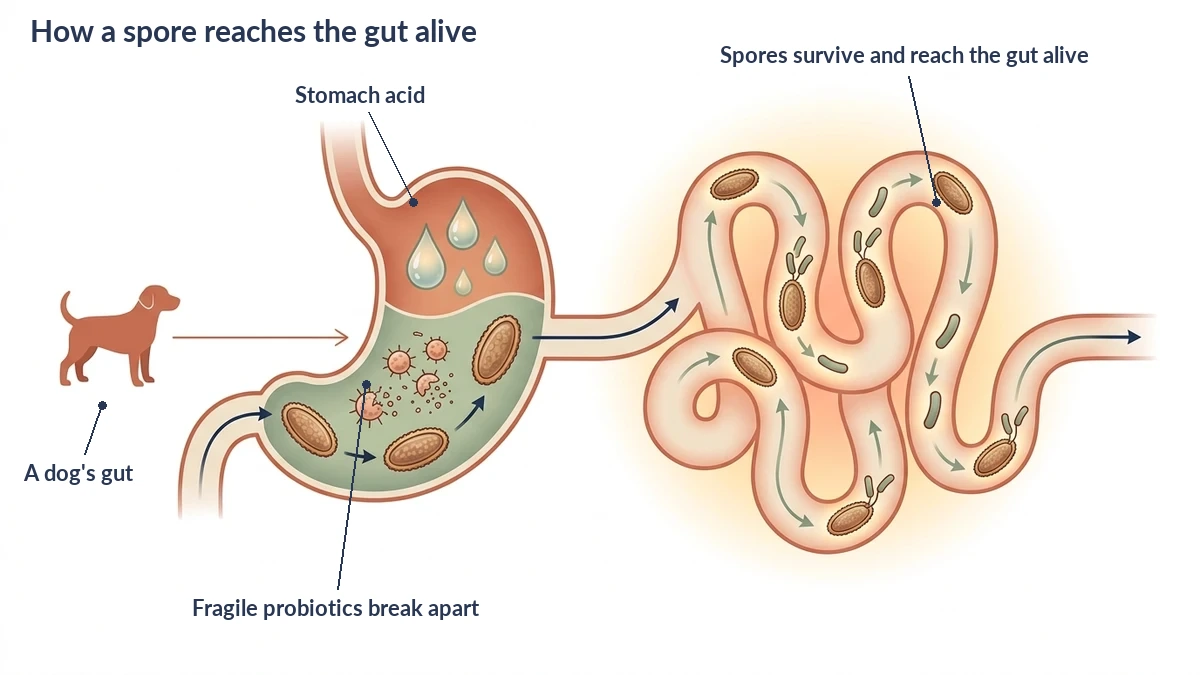
The first is survivability. Most probiotic bacteria are fragile. Swallowed, they hit stomach acid and a lot of them are destroyed long before they reach the gut where they're supposed to set up. The cheap shelf tubs and the refrigerated powders are the worst offenders: you can pay for a month of bacteria that mostly arrive dead. The second is the strain: a lot of products use whatever's cheap rather than the specific organisms shown to do something in dogs.
There's a class of bacteria that gets around the first problem. Spore-forming organisms travel inside a tough natural shell. They evolved to survive out in soil and raw prey, which happens to be exactly the armor it takes to ride through stomach acid and reach the intestine alive, where they "wake up" and get to work. The lead one studied for this is Bacillus subtilis: a 2021 paper in Frontiers in Microbiology confirmed its spores survive gastric acid intact and germinate in the gut. The protective shell is the whole difference.
This is why "a better probiotic" is the wrong way to think about it, and why a brand called Rooted Paws doesn't call its Gut & Skin chews a probiotic at all. They put it in its own category: Soil-Born Spores, named for the soil-tough, spore-forming microbes a dog's gut evolved alongside and that high-heat kibble strips out. After you've tried "a probiotic" and watched it do nothing, new is the only frame that's honest. You're not buying a slightly better version of the thing that failed. You're putting back something different.
So what actually holds?
If you sat down and designed a daily routine from everything above, it would have to do three jobs at once, and survive contact with a real dog and a real, tired owner. Put the good bacteria back in a form that arrives alive. Feed them so they take hold instead of washing straight through. And do it every day, because a thinned-out gut doesn't rebuild from one good Tuesday.
That's the shape of what Rooted Paws built into a single chew:
- Arrives alive. The lead strain is spore-forming Bacillus subtilis DE111®, the kind shown to survive stomach acid and reach the gut intact. So you're not feeding your dog dead bacteria.
- Restocks and feeds, together. It pairs a multi-strain blend (including the Enterococcus faecium that the Frontiers/MDPI work links to shorter bouts of diarrhea in dogs, plus Lactobacillus and Bifidobacterium) with prebiotic pumpkin and chicory inulin, the food that helps the new microbes settle in. (Bacteria plus their food in one place is what's called a synbiotic.)
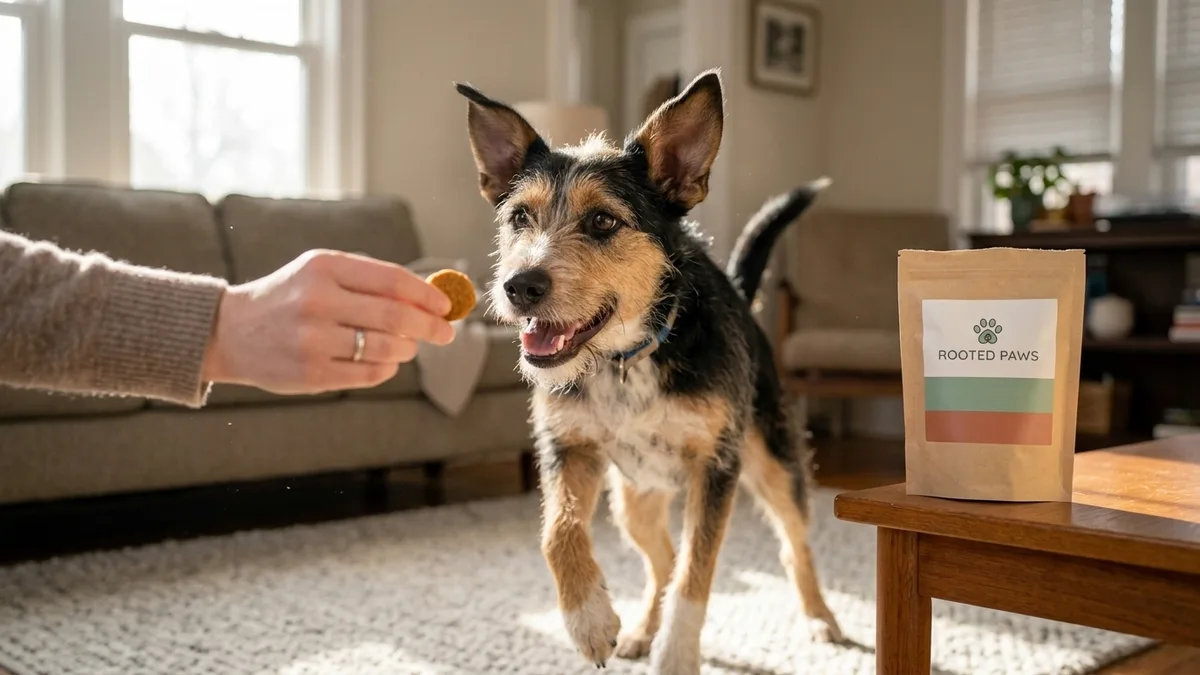
- Fits the dog who can't handle another change. It's a chicken-and-pumpkin soft chew you hand over like a treat: no powder to refuse, no pill to spit out. And the part that matters most if you've already cycled through three bags and three carpet shampoos: you don't change what you're feeding. You add this on top. No new variable, no fresh week of loose stool while the gut adjusts to a different food.
On timing, the honest version, because you've been burned by the overnight-miracle pitch before: most owners watching closely see the stool firm up over the first two to four weeks. The skin and coat run on a slower clock. The itch is downstream, so it eases after the gut does, often over a couple of months. Anyone promising you a fixed dog by Friday is selling you something.
It's built for that specific dog: the chronically gassy, soft-stool, paw-licking, faintly-yeasty one, any age. It is not an emergency fix, and it doesn't replace ruling out a true food allergy or the serious stuff with your vet. It's the daily floor underneath that work.
The math, if you're still skeptical
You should be skeptical. You've bought the tub that promised the world and did nothing. So run the numbers the way you'd run them on anything else.
A bag is $36.95 (less on subscription) against the $200 vet visit that ends with the same "could be anything," or the $300-a-month prescription bag, or the $2,000 you've already lost to this. Rooted Paws backs the chews with a 90-day money-back guarantee, no hoops. So the real downside of trying one bag is close to nothing, and the upside is the version of this that finally holds.
When it works, it tends to go in the same order, the bowl first, the paws a few weeks behind:
"Three foods, two dewormers and a $400 workup later, this is the thing that finally firmed him up. A month after that, the paw-licking eased off too. I wish I'd understood the connection a year ago."
"My fussy one won't touch powders. He thinks the chew's a treat. That's the only reason we stuck with it long enough to see it work."
Everything you tried did something. It just worked on one end of a problem that has two. The loose stool and the itchy skin were never separate bad luck. They were one thinned-out gut, showing up twice. The only question worth asking about anything new is the one the research actually answers: does it arrive alive, is it a strain shown to do something in dogs, and are you giving it daily? Three yeses, and you're finally covering the cause instead of the symptom.
Individual results may vary. This product is a supplement, not a medicine. It is not intended to diagnose, treat, cure, or prevent any disease. Owner quotes above reflect representative experiences reported with this category of chew.
Rooted Paws supports your dog's care alongside your veterinarian; it is not a replacement for veterinary diagnosis or treatment. See your vet for persistent diarrhea, blood in stool, weight loss, or lethargy.
See how Rooted Paws Gut & Skin Daily Chews work →
You already do the hard part. Anyone who's scrubbed a rug at 3 a.m. does. This is just the easy bit you haven't tried yet.
Sources
- Probiotics ameliorate atopic dermatitis by modulating gut microbiota dysbiosis in dogs: Frontiers (2024)
- Application of Probiotics in Cats and Dogs: Benefits and Mechanisms: Veterinary Sciences, MDPI (2025)
- Gut Probiotics and Health of Dogs and Cats: Benefits, Applications, and Mechanisms: review (PMC)
- Bacillus subtilis spores survive gastric acid and germinate in the gut: Frontiers in Microbiology (2021)
- Signs a dog may benefit from probiotics (loose stool, gas, itch, post-antibiotic, food change): Vetnique / PetMD / AKC