It wasn't my dog's age. It was the bag in the pantry.
For four months I had been reading dog-food forums at the kitchen table after midnight. On the afternoon I am about to describe, I finally stopped.
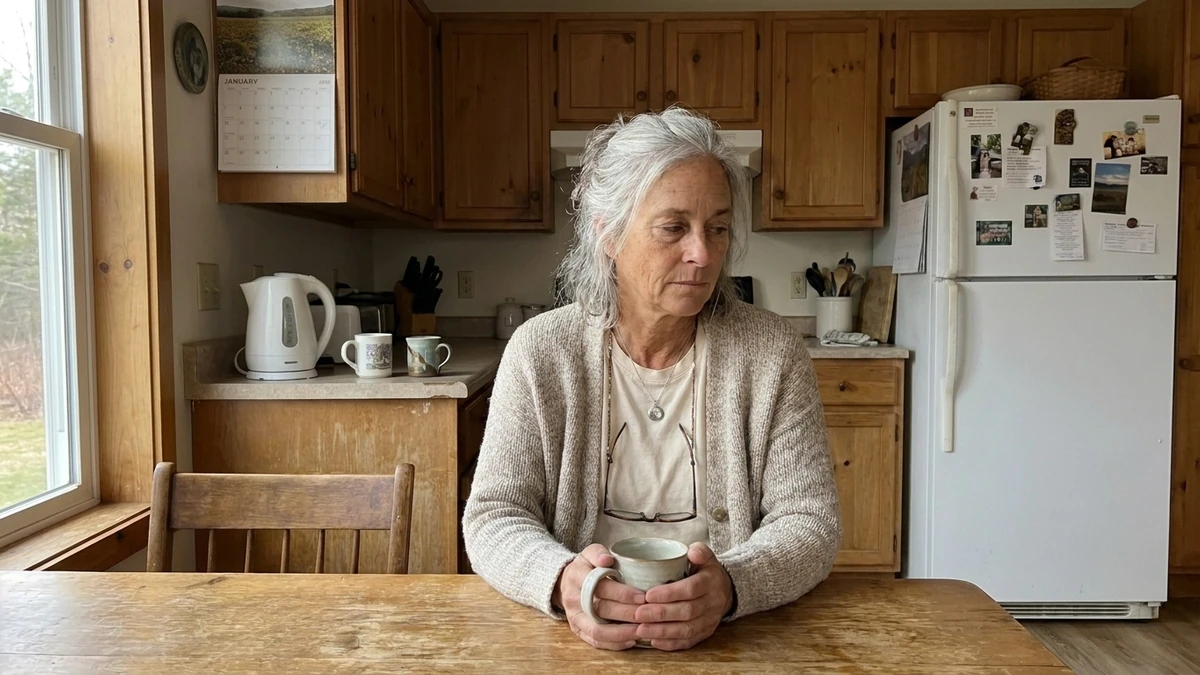
Cooper is thirteen. He is a golden-mix from a rescue down in Hendersonville, and he has lived with me his whole life in the same small craftsman house off Charlotte Street, here in Asheville, where I taught second grade for thirty-one years before I retired and where the rooms are too quiet now that the school day no longer lives in them. Cooper has the kind of golden-mix coat that used to throw back amber in good afternoon light. The amber has been gone for about a year. The light hasn't.
The bowl on the kitchen floor is still half-full from breakfast. The pantry door is open. My right hand is resting on the top shelf where the bag of premium kibble lives — the same shelf, the same hand, the same Sunday-afternoon gesture I have been making for twelve years.
I do not reach for the bag.
I close the pantry door, and I sit down on the kitchen floor next to Cooper.
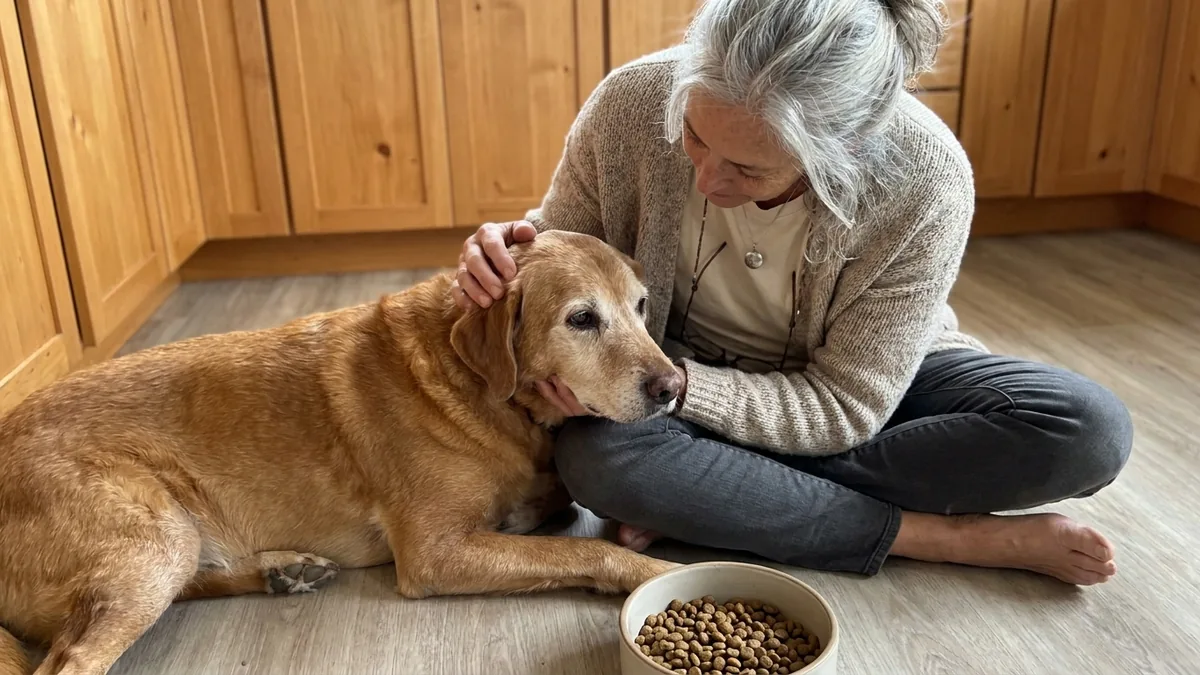
Eight months ago I sat in the green-walled exam room of the veterinary clinic Cooper has gone to since he was a puppy and listened to his vet — a good man, a careful man, the same one who got us through the puppy shots and the weird limp at age four and the time he ate a sock at Christmas — say, gently, "It's probably just old age, Maggie. He's 13. We can talk about a prescription joint diet." We did the bloodwork first; it came back clean, no specific disease. We started the prescription joint diet three weeks later.
It helped with his mobility. He climbs the porch stairs less stiffly than he did a year ago — still slow, still one at a time, still that small pause on the second step, but the second step is no longer the wall it had become. The joint diet did what a joint diet can do. There was something else, though, that I had been watching dim, week by week, that the joint diet did not touch. The dull coat. The eyes that no longer expect. The half-full bowl.
I had been calling it old age. I had been calling it old age every morning for eight months, while at night I had been reading every thread I could find about other people's senior dogs — doing the thing a retired teacher does, which is research a question to the point where the answer becomes unavoidable, and then go three more weeks pretending I hadn't read it yet.
That afternoon was when I stopped pretending.
The bag I never questioned
I want to be clear about what I had tried before that afternoon, because I do not want you to think I had not tried.
The closet in the laundry room is where I keep the dog food that didn't work. There is half a bag of the premium kibble the breeder recommended when Cooper was a year old — the brand I am still buying, the one in the pantry, the one I came in here to refill from. There is a sealed pouch of the wet food I added as a topper in early spring when his appetite first wobbled. There is a half-eaten subscription delivery of fresh food in a refrigerated tray with my name on the side. There is the prescription joint diet from the vet — sealed for the first week, half-eaten now. Cooper liked it, at first. Then he stopped liking it. There are three different bags of treats. There is, in the back, an unopened bag of something called gently cooked that I bought at the boutique pet shop on Merrimon Avenue and could not bring myself to open after he turned his face away from the wet food I had spooned over the last meal of the previous brand.
The shelves look like a small archive of trying. They look like love. They also look like the inside of someone's head when she has been trying to fix a problem with the same general approach for two years and the problem keeps not being fixed.
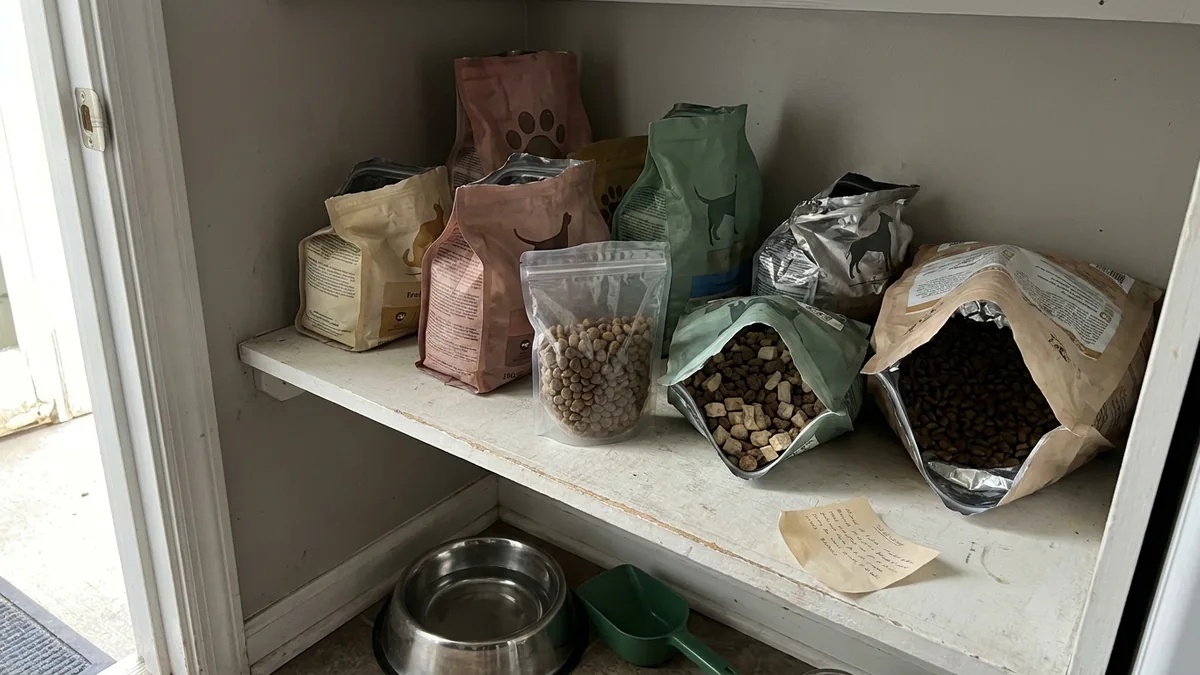
What I had not let myself see, sitting on the kitchen floor in the late-afternoon light, was that every single bag in that closet — without exception, including the one in the pantry I had been about to refill from — had one thing in common.
Every one of them had been cooked.
Some at high heat. Some at lower heat. Some marketed as premium, some as holistic, some as science-formulated, some as ancestral, some as gentle. Different price points. Different ingredient panels. Different stories on the bag. I had paid more for some of them than I had paid that month for some of my own groceries. All of them, cooked.
I had read enough by then to know what high-temperature cooking does to protein. I had read enough by then to know the chemistry of it, in the rough — the broad strokes a retired teacher who has been a careful reader her whole life can absorb without becoming a chemist. I had even bookmarked the papers, the way I used to bookmark articles to send to the more curious parents at conferences. What I had not done was look at the bag in my own pantry and ask whether the constant in Cooper's life — the only constant in his life — was the thing that had been quietly working against him.
I wanted to do right by him. That is the sentence that has been running underneath everything for the last two years. I wanted to do right by him, so I bought premium. I wanted to do right by him, so I added the wet food. I wanted to do right by him, so I tried the fresh subscription. I wanted to do right by him.
And the dog kept getting quieter.
What I learned about what's actually in the bag
I am going to tell you the embarrassing part next.
One name had been coming back in the threads I had been reading. Coming back in two directions at once, which was part of why I had been ignoring it. Half the posts were calling him a scam — the kind of older veterinarian who runs ads before recipe videos, the kind of brand everyone on Reddit had been muttering about for years. The other half were owners of senior dogs who said their dog had turned a corner on the food.
I had been firmly with the first half. I have, in general, a low opinion of older veterinarians whose faces I keep seeing in advertising. I have an especially low opinion of being marketed to in places I went looking for something else.
But that afternoon, after I had put Cooper's untouched bowl in the sink, I did the thing I had been refusing to do for four months, which was open the man's own published writing instead of letting the threads decide for me.
The veterinarian's name is Martin Goldstein. He went to Cornell, graduated in 1973, and spent the next forty-five-plus years at a clinic in South Salem, New York — Smith Ridge — where the cases that came through the door were the chronic and degenerative ones the conventional clinics had run out of moves on. He wrote a book about it in 1999, The Nature of Animal Healing, which I had actually heard of, because it had been mentioned more than once on the saner end of the senior-dog forums I had been reading. He retired from active practice in 2019. The brand on the ads is, more honestly, the work he has handed forward into a nutrition formulation after spending four decades watching what real food does for dogs whose owners had given up.
I read for an hour. I read his own words, not the threads' summary of them.
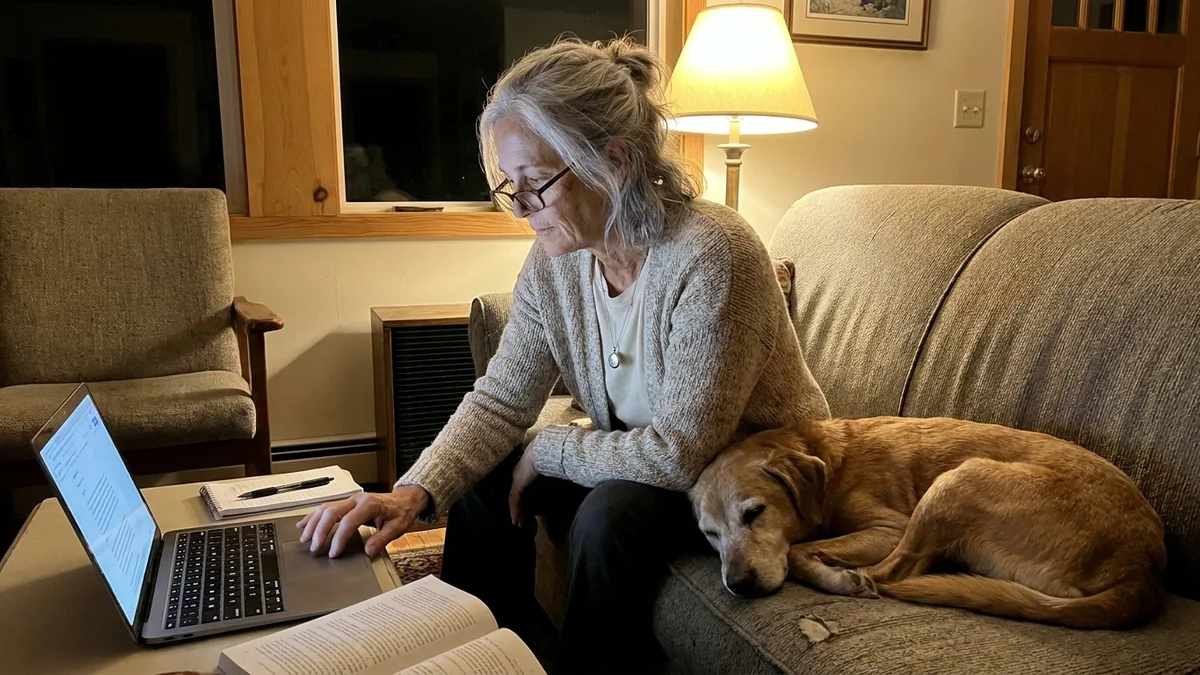
He had spent forty-five years observing — observing, not theorizing — that the dogs who came back to him after switching to a real-food diet, the kind made of meat and organ and vegetable and fruit, the kind a human being would recognize on sight, were the ones whose owners would write him a year later to say he doesn't seem as old as he was. In his own published words: after treating thousands of dogs over four decades, what he kept seeing was that the artificial preservatives, the cheap fillers, the meat by-products in much of what is sold to American pet owners as "premium" pet food were, in his observation, speeding up the signs of aging. He said wholesome, real food, in his clinic, again and again, brought even older dogs back to seeming more playful and youthful.
The phrase that landed was that one. Even older dogs. Not even sick dogs. Not even young dogs. Even older dogs.
He was careful, in the way that a veterinarian who has been writing for forty-five years has learned to be careful. He was not claiming the food cured anything. He was not claiming any disease had been undone. He was saying, plainly, that the cumulative load of conventionally processed pet food on a dog's body, over twelve years, is not a neutral input. High-heat cooking has a cost. It takes things away from the protein. It leaves things behind that a dog's body was not designed to process. You do not, he said, need to understand the chemistry of any of it to feel the consequence of it. You just have to feed your dog, for twelve years, something that has been cooked at a temperature high enough to make it survive a warehouse, and then notice — when he is thirteen and beginning to fail — that the only constant in his life is the bag.
I had read sentences like that one in the threads for four months. I had not let myself read them in his own voice until that afternoon.
The day I closed the pantry
The product Dr. Marty makes is called Nature's Blend.
It is freeze-dried — which is to say, the meat and the organs and the vegetables and the fruit are dried by removing the water at a low temperature, so the food preserves without being cooked. The bag is shelf-stable. The ingredient list reads like a grocery list a person would recognize on the first try, with a senior variant that adds tart cherry and New Zealand green mussel for joint and immune support. Eighty-one percent of the bag is meat. There are no artificial preservatives, no fillers, no by-products.
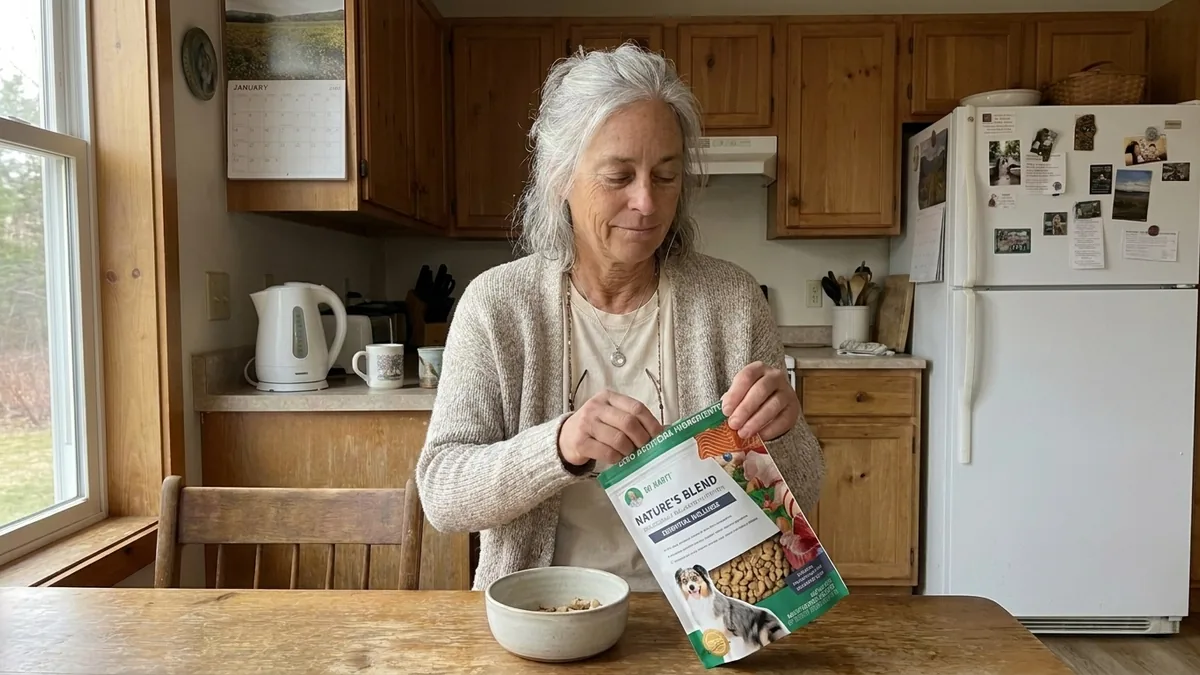
Individual results may vary. This product is not intended to diagnose, treat, cure, or prevent any disease.
I am writing that sentence on purpose, the way Dr. Marty's team writes it, because I am a former teacher and I respect language.
I am not going to tell you Cooper is a new dog. I am going to tell you what happened when I tried.
The first thing I did, that evening, was read other owners' letters. The brand keeps them on the product page. Most of them I skimmed. One stayed with me. A woman named Hannah, in Sarasota, Florida, wrote about her Maltipoo, Gidget, who was almost fourteen when she started feeding her Nature's Blend. Hannah said Gidget had started to look old. She said — and I am paraphrasing her observation, not her diagnosis — that within a few weeks the dog seemed to be visibly turning the clock back. She used the word transformation. I do not, generally, trust the word transformation in marketing copy. I trusted it from Hannah because Hannah was not selling me anything. Hannah was writing the letter I had not yet had the courage to write.
I ordered one bag. The brand's ninety-day money-back guarantee was, in the end, what let me press the button. Not because I expected to need the refund. Because the company was willing to stand behind the bag for ninety days, which was longer than I had been willing to stand behind the bag in my own pantry.
I want to tell you what happened next without overpromising, because Cooper is thirteen years old and thirteen years of biological aging is real and irreversible and no bag of food is going to turn him back into the dog he was at five. I am not asking for the dog he was at five. I am asking for more good days with the dog he is now.
In the first week he ate the bowl. He ate the whole bowl, both meals, the way he used to eat at age seven. The first time in eight months I had stood in the kitchen at dinner and watched a dog be hungry.
In the second and third weeks his coat — I had not used the word amber about Cooper's coat in over a year — started, in the afternoon light coming through the kitchen window, to look like a coat that knew it had once been amber.
The porch stairs are still slower than they were at age seven. He still pauses on the second step. He always will. But on a Tuesday in the fourth week he met me at the kitchen doorway at six-thirty in the morning, the way he used to, with the small impatient puddle of saliva on the linoleum, and looked up at me like he had something specific he wanted, which was breakfast.
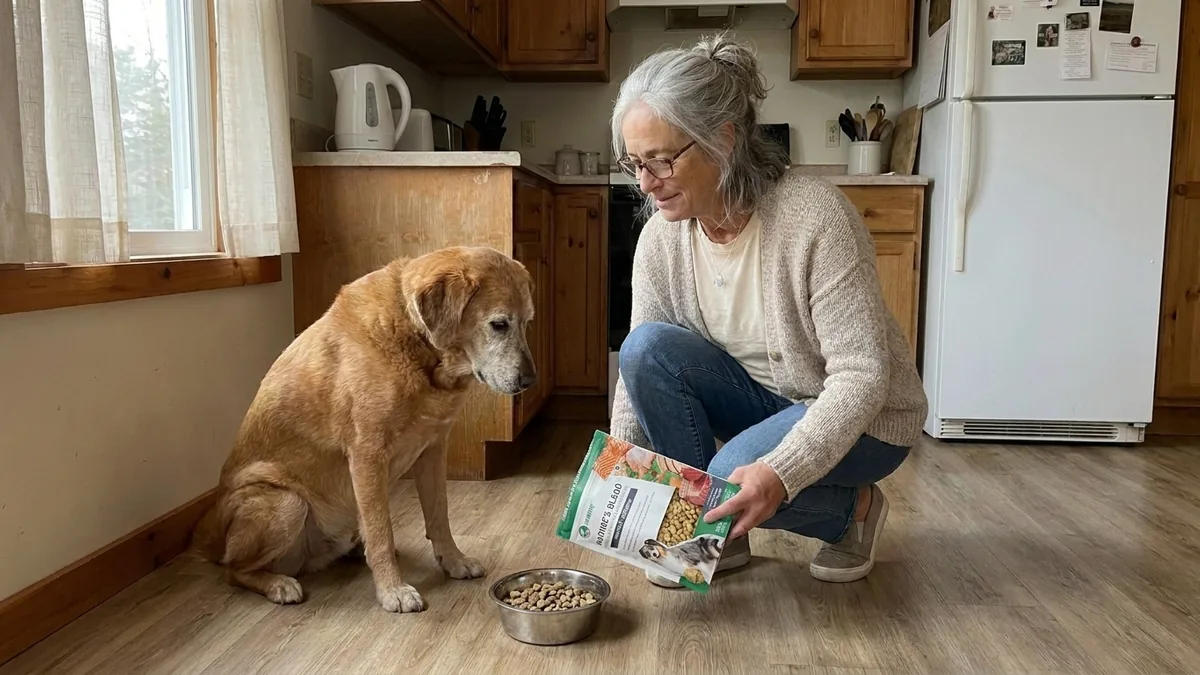
I put the half-bag of kibble in the trash.
It was the first time in twelve years.
Consult your veterinarian before making significant changes to your pet's diet, especially for senior pets or pets with existing health conditions.
Cooper is still thirteen. None of what I am writing is a claim that any food has undone his age, or fixed any disease, or turned him into a different dog. Some of the decline I had been watching is real and is going to stay real, and I am, like every owner of a senior dog, going to have to learn to live with that. But the part of it I had been calling old age — the part of it I now suspect was the cumulative weight of twelve years of cooked food — has, in my own kitchen, on my own dog, started to look different.
If you have a senior dog and a closet of half-bags and the same question I had — is the constant in his life the thing that has been quietly working against him? — there is a longer version of Dr. Marty's approach, in his own words, at the link below. I do not know if Nature's Blend is the right bag for your dog the way it has so far been the right bag for Cooper. The only person who can know that is the person who watches the bowl every morning.
You have earned the right to ask the question. He has earned the right to be tried for.
Read the rest of Dr. Marty's approach →
Yours in the love of dogs,
— Dr. Marty's editorial team
Sources
- Dr. Martin Goldstein, DVM (Cornell University DVM, 1973), founder letter and product material — drmartypets.com
- Hannah, Sarasota FL — Consumer Affairs verified customer review of Nature's Blend, posted March 18, 2026 — consumeraffairs.com
- Dr. Goldstein's clinical career at Smith Ridge Veterinary Center, South Salem NY (active practice 1973–2019; integrative medicine focus on chronic and degenerative illness) — smithridge.com